Anik

@anik

Hey, I am Anik from Bangladesh. I am a software engineer and a researcher with an obsession towards Language Models and their applications.

Research Interests

  1. 01

    Why do small models fail to use what they retrieve, and can we fix it without scaling them?

    Reliable Small Language Models

    The idea of a small language model running locally on consumer hardware with minimal resource usage, accomplishing focused tasks as efficiently as LLMs, fascinates me. In a world where the privacy of personal data is becoming more important than ever, there is a growing need for models that can perform specific tasks reliably and efficiently without the need of cloud-based services or requiring extensive computational resources.

    note · 01

    Keywords: small language models · reliability · context utilization · retrieval-augmented generation

  2. 02

    When does model capability become a bottleneck for Multi-Agent Collaboration?

    Reliable Multi-Agent Systems

    AI agents collaborating with each other and executing complex tasks will never cease to amaze me. However, after working on multiple such systems, I have realized that a lot can go wrong among collaborating agents. I am interested in understanding the challenges that arise in multi-agent collaboration, why agents fail to coordinate effectively, and how we can build more reliable and robust multi-agent systems especially with constrained model capability.

    note · 02

    Keywords: multi-agent systems · communication topology · error propagation · process-level evaluation

  3. 03

    Can vision-language models understand culturally grounded content in languages they rarely saw during training?

    Multimodal Understanding in Low-Resource Languages

    Most multimodal benchmarks are built for English. In Bengali, a meme's meaning often hinges on local politics, pop culture and wordplay that models rarely see. Through my work on Bengali memes, I am interested in how vision-language models handle culturally grounded content, and what it takes to make them reliable for low-resource languages.

    note · 03

    Keywords: multimodal understanding · vision-language models · low-resource languages · Bengali · memes

Publications

  • Journal
  • Conference
  • Workshop
2026

AgentCollabBench: Diagnosing When Good Agents Make Bad Collaborators

Aritra Mazumder, Shubhashis Roy Dipta, Nusrat Jahan Lia, , Al Jami Islam Anik, Al Nafeu Khan

Conference:NeurIPS 2026 · Datasets and Evaluations Track · Poster

Workshop:ICML 2026 · Workshop on Failure Modes in Agentic AI (FAGEN) · Poster

pdf ↗arxiv ↗

Abstract

Multi-agent systems achieve state-of-the-art outcomes through peer collaboration. However, when an agent in the pipeline silently drops a constraint, the system's final output may look correct even though the reasoning chain was quietly corrupted, and existing outcome-based evaluations are blind to such multi-hop process failures. To make these vulnerabilities measurable before deployment, we introduce AgentCollabBench, a diagnostic benchmark of 900 human-validated tasks spanning software engineering, DevOps, and data engineering. Each task isolates one of four behavioral risks: instruction decay (does a constraint survive peer pressure?), false-belief contagion (does a falsehood spread through consensus?), context leakage (does information bleed between tasks?), and tracer durability (does marked data reach the final agent?). Evaluating four modern LLMs (GPT 4.1 mini, Gemini 2.5 Flash Lite, Qwen-3.5-35B-A3B, and Llama 3.1 8B Instruct), we expose model-specific vulnerability profiles invisible to outcome-only evaluation; Qwen-3.5-35B-A3B, for example, leads on tracer durability and instruction stability, while GPT 4.1 mini leads on leakage containment and false-belief resistance. Beyond per-model differences, communication topology emerges as a primary risk factor that explains 7-40% of the variance in multi-hop information survival. The effect traces to a synthesis bottleneck specific to converging-DAG nodes: an agent weighing competing parent inputs discards constraints carried by a minority branch, a bottleneck structurally absent from linear chains. AgentCollabBench demonstrates that suboptimal topology can silently erase the safeguards of highly capable models, arguing that multi-agent reliability is fundamentally a structural problem and that scaling model intelligence alone is no substitute for architecture.

NeurIPS 2026

2026

Analyzing the Semantic Roles in Bangladeshi Memes: A Multimodal Approach to Contextual Role Labeling and Explanation Generation

Al Jami Islam Anik, Ahsan Shariar Khan Mazlish, Syed Mahbubun Nabi, Mustafis Ahsan, Jannatun Noor

pdf ↗

Abstract

Understanding who plays which narrative role in a meme requires jointly interpreting the image, embedded text, and culturally specific context. This is particularly difficult for Bengali memes, where resources and annotated benchmarks are limited and most prior work targets coarse tasks such as hate speech or sentiment detection rather than entity-level narrative roles. Bengali meme understanding is formulated as an entity-centric role labeling and explanation task. To support this setting, a dataset of Bengali memes is curated and annotated with role labels (hero, villain, victim, and other), along with context notes used to resolve culture-dependent references. Two complementary multimodal solutions are evaluated: (i) a triple-stream fusion classifier that integrates visual, textual, and context signals via attention-based fusion, and (ii) a vision–language reasoning pipeline that performs holistic inference over full meme content and produces explanations. Methodologically, the work contributes an entity-centric benchmark with context annotations and evaluates attention-based fusion and vision–language reasoning for role labeling and grounded explanation generation. Practically, it enables culturally grounded analysis of Bengali memes for downstream understanding of satire and social commentary in real-world social-media content. Experimental results show that the vision–language pipeline improves over the fusion baseline on role labeling. In addition, the explanation generator improves rubric-based explanation quality under a multi-model judging setup.

Engineering Applications of Artificial Intelligence 2026

Honors & Awards

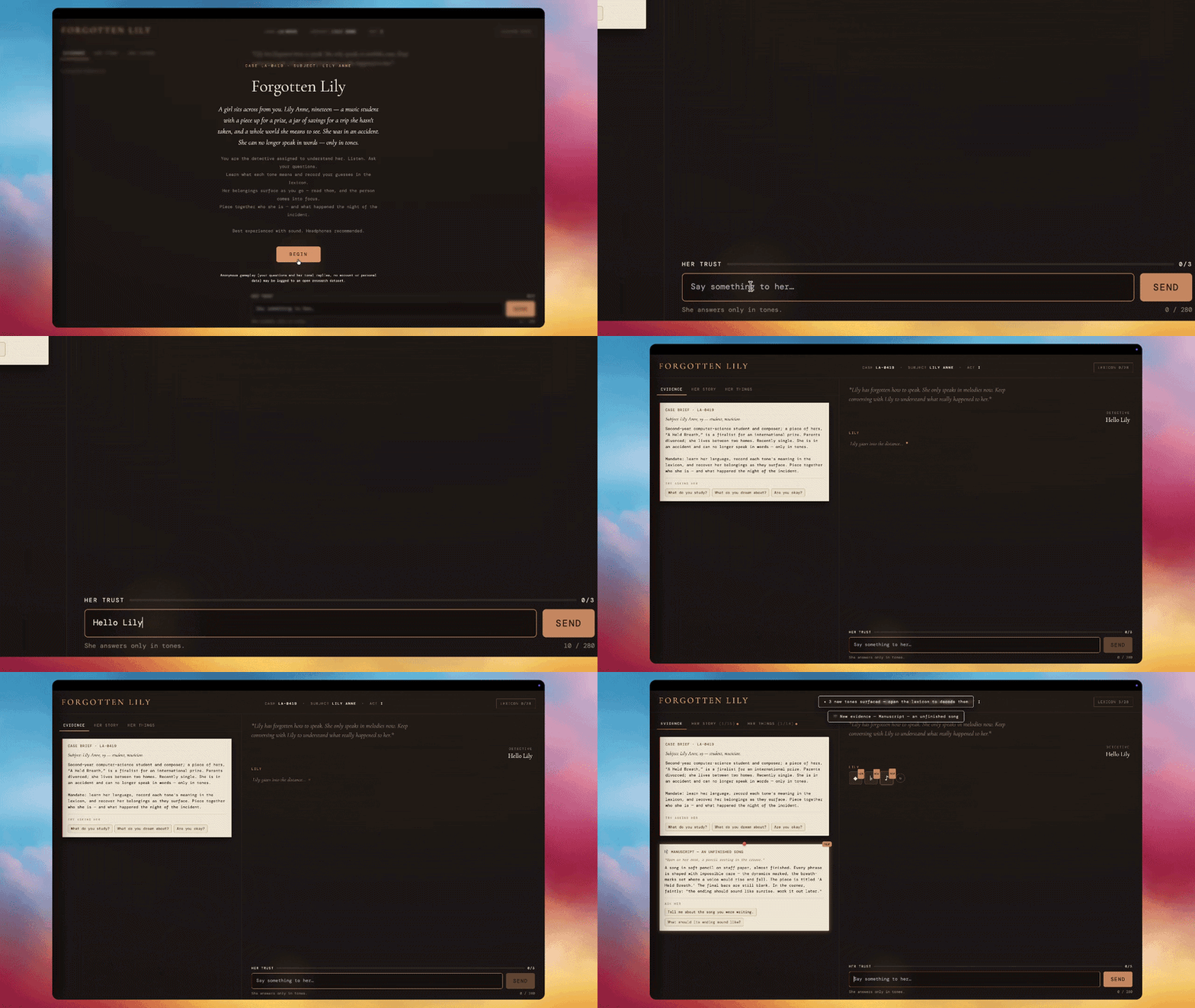
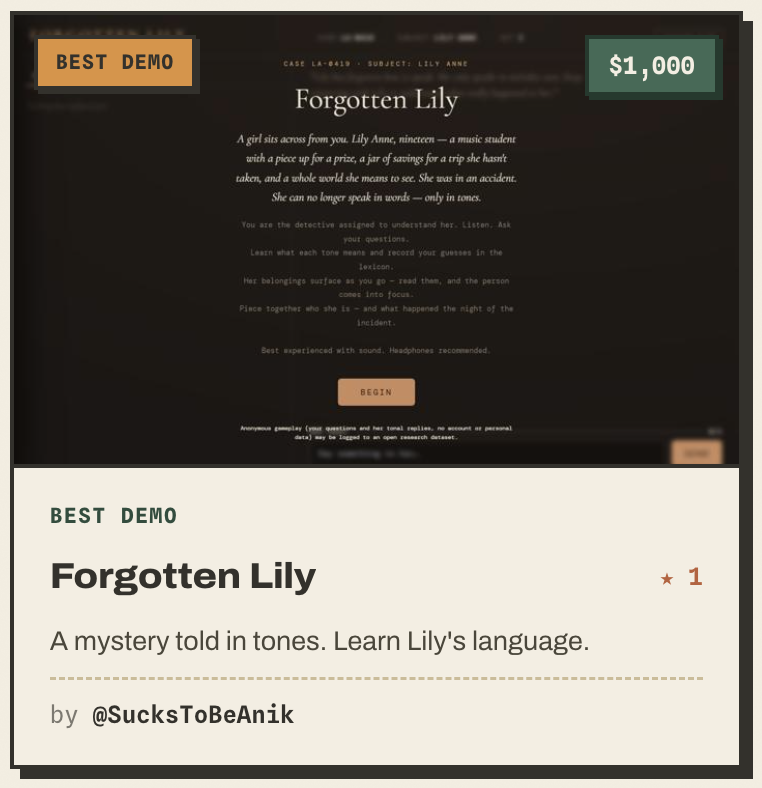
Best Demo Award ($1,000)

Hugging Face & Gradio Build Small Hackathon 2026 (global), for Forgotten Lily

2026

Vice-Chancellor's List

BRAC University · Fall 2022, Fall 2023, Spring 2024, Summer 2024

2022–2024

Dean's List

BRAC University · Spring 2022, Summer 2023, Summer 2025

2022–2025

1st Place, IntraHacktive 1.0

BRAC University hackathon

2025

5th Place, Innovation Cohort, BUET Rise

Raised initial funding for our VR product

2025

Education

Industry Experience

Joined Casemax Plus

Building a legal AI product for the mortgage foreclosure domain alongside lawyers, helping legal teams navigate case workflows and documentation at scale.

Software Engineer

2026–

Joined Askturing

This was my first job and I left after almost two years of working there.

Software Engineer

2024–2026

Recent Posts

View all

Projects I am proud of

View all

A few frames I keep coming back to. The rest of the roll is here.

so, how do I reach you?

well, email is the most reliable. send it from here and it lands in my inbox.

bruh, email is so oldschool. how else do I reach you?

fair. any of these work just as well.

and if I have more questions?

ask here. do let me know if the ai leaks any social credits.

Ending on a note I try to live by

“Simplicity is the ultimate sophistication.”

Al Jami Islam AnikAnik